
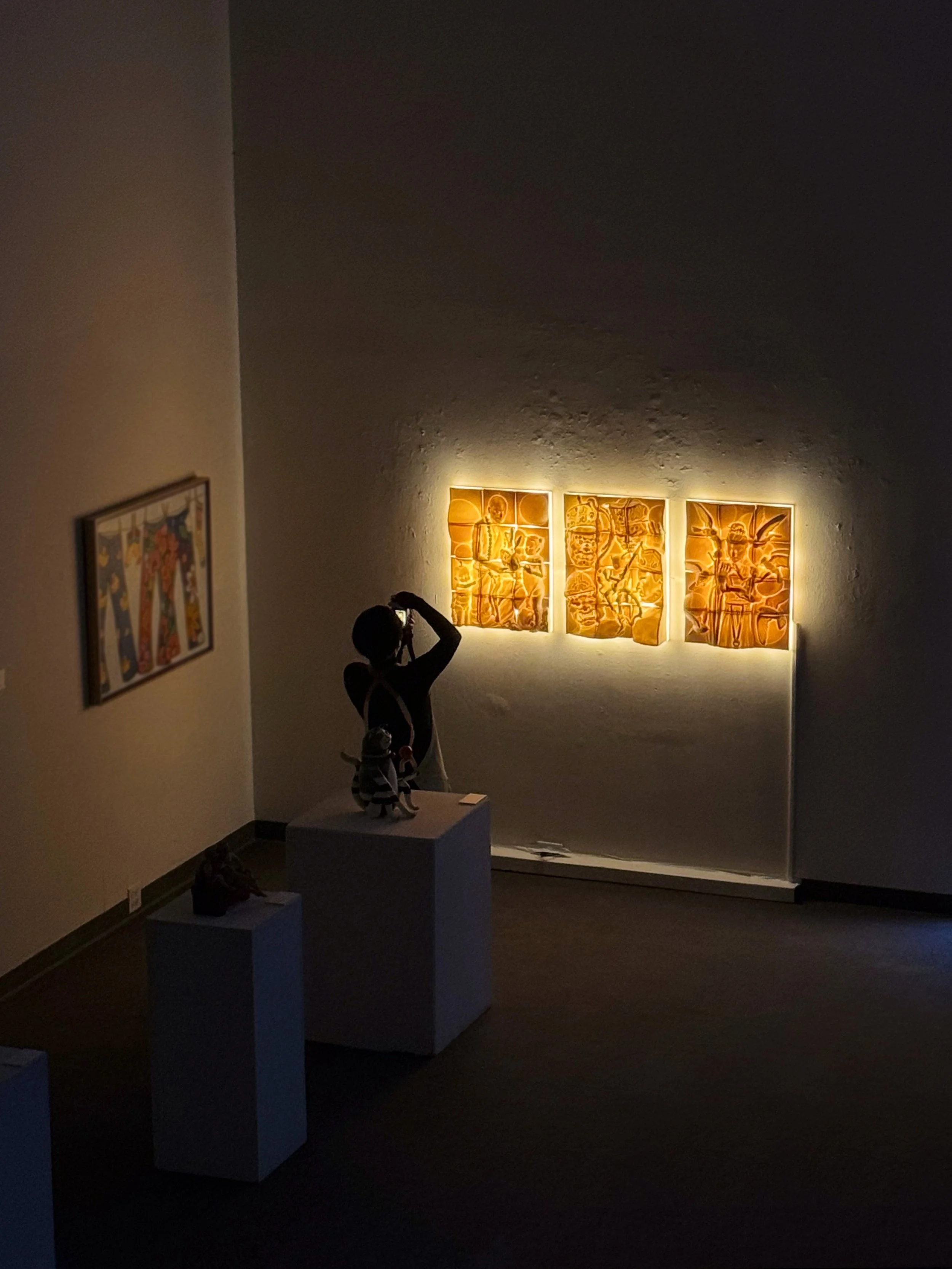
Yoyo Hu is a Chinese-born sculptor and installation artist based in California. She grew up in Chongqing, a city built inside mountains, where her path to school wound daily up stone staircases worn smooth by generations — an early, unspoken education in what bricks remember.
Hu trained first as a painter before finding her direction in the clay figures and murals of ancient Chinese temples. Struck by the capacity of fired earth to hold not just form but feeling — tenderness, grief, spiritual presence — she turned toward sculpture, and eventually toward the construction of entire environments. Her practice now combines 3D modeling, 3D printing, mold-making, and slip-cast ceramics to build large-scale architectural installations in which figures drawn from Chinese mythology inhabit hand-designed bricks: imprisoned within the material, as memory is imprisoned within the body.
Central to her work is a conviction: that a person does not truly die when their body ceases to exist, but when they cease to exist in anyone's memory. Her installations are conceived as future ruins — structures built now to outlast the people who carry them. The ceramic surfaces accumulate cracks and ruptures during firing, the digital precision undone by heat; this uncontrollable transformation is not a flaw but the work's essential argument: that what we make with the most advanced tools available is still subject to forces older than any technology.

In a temple in Shanxi, I stood before a clay sculpture of the Ghost Mother. What stopped me was not her form, but her gaze — a look of tenderness and compassion that I had only ever seen on a mother's face as she may watch her child. I understood, in that moment, why it struck me so deeply: it was my grandmother's face. A woman I never knew, who passed away when I was one year old, whose warmth I can only access through my mother's stories.
My grandmother survived the bombing of Chongqing during World War II. She was a child then, and the air-raid shelters were so crowded that she couldn't breathe. One day, when the air raid siren sounded again, she made a decision: she stayed home, lay down on her bed, and thought — If I die, I die. She survived. That act of quiet defiance has lived in my imagination ever since.
I was born in Chongqing, a city built inside mountains. My path to school ran up stone staircases with no visible end, each step worn smooth by generations of feet. Those stone bricks held my childhood. I did not know then that I was already learning something about what material can carry.
I studied painting first, but could not find my voice in it. What drew me were the clay figures and murals of ancient temples — mythological, fierce, achingly human — the kind of art that does not represent a soul but is one. In graduate school, I began sculpting characters from Chinese myth and folklore. But a figure alone was not enough. I wanted to build entire worlds — the immersive atmospheres I had felt inside cave temples and ruined shrines, where architecture, image, and spirit become a single experience.
The answer came from an old story. Meng Jiangnü wept so hard at the Great Wall that the stones crumbled, releasing her husband's bones from inside. Each brick is a vessel of human labor, suffering, and memory. A relic is not just a remnant — it is a container of souls.
I began making bricks.
The taotie masks of the Shang dynasty — those faces without bodies cast into bronze, their meaning still unresolved after three thousand years — represent a time when human imagination ran without boundaries. They were made to hold something language could not contain: awe, fear, the presence of forces larger than the human. But as civilization ordered itself into ritual and reason, that capacity for mythological thinking was gradually constrained. The line between the ancient imagination and the present was not broken all at once — it narrowed, slowly, over centuries. What I make is, in part, a longing for what that openness once held, and an attempt to practice it still.
This impulse, though, belongs to no single civilization. The earliest human objects — Shang bronzes, African tribal masks, the painted vessels of indigenous Americas — were all doing the same thing: pressing the invisible into the touchable. Before writing, before rational explanation, human beings already understood that certain things could only be carried in form, not in words. My bricks continue that tradition — not the tradition of any one culture, but the older, wider human instinct to make something with your hands when you have no other way to hold what you feel.
I believe that a person — or a civilization — does not truly die when their body ceases to exist. They die when they cease to exist in anyone's memory. The brick is the container I have chosen: not for a monument, but for preservation. My grandmother's decision on that bed, my mother's voice telling the story, the gaze of that clay figure in Shanxi — if I do not build them into something material, they will disappear when I do. The brick is my argument against that potential disappearance.
My first attempt to embed handmade figures into brick forms failed — hand-sculpting could not hold the structural consistency I needed. That failure led me to 3D modeling and 3D printing. When a precisely modeled digital surface is fired into ceramic, it develops cracks, irregular textures, and unintended ruptures. The algorithm becomes material. The machine's ideal is undone by fire. The digital body acquires the fragility of flesh.
This is the paradox at the center of my practice. I use the most advanced technologies available to reconstruct something ancient, only for the ancient material to absorb and transform the digital. The result is neither purely handmade nor purely technological — it is a hybrid artifact: a relic of the present moment.
I left China carrying memories I cannot fully articulate — the smell of incense in mountain temples, the weight of mythologies absorbed before I had language for them. Living in America, those memories do not fade; they become petrified. They become the sediment from which I build.
My installations are imagined as future ruins — scenes from a past that never quite existed and a future that hasn't arrived. The Ghost Mother moved me because her tenderness was not abstract. It was the love of one person for another, made permanent in clay. My grandmother lay down on her bed and decided to live or die on her own terms — and somehow, that surrender became survival, which allowed my mother to exist, which brought me to that temple, to stand before that figure, and to understand what fired earth can hold.
I do not offer answers about what endures. I offer structures — fragile, monumental, cracked — and ask you to consider what is kept inside them.